
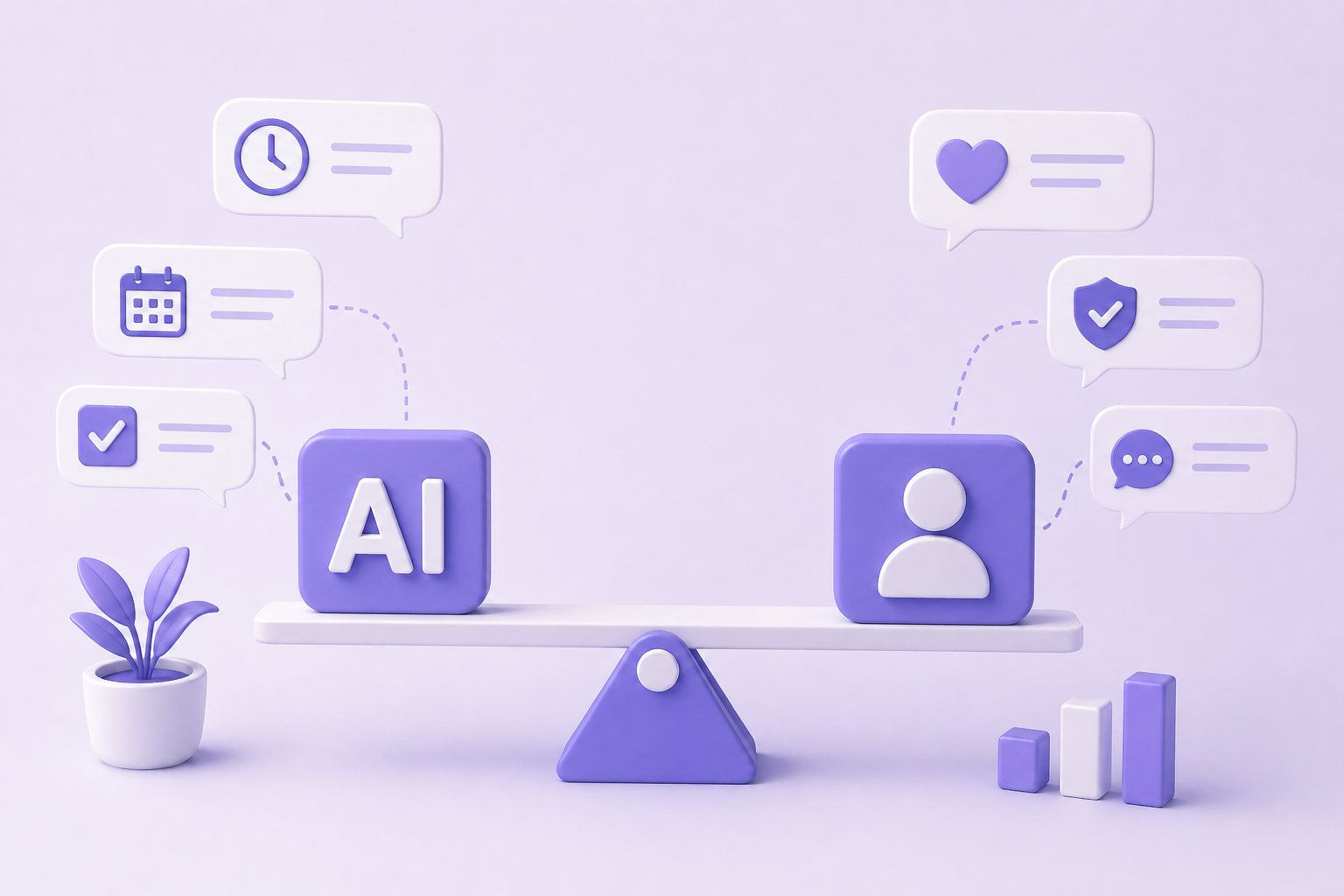
Most small businesses we speak to around Manchester do not need “more automation”, they need fewer customer service fires. AI customer service can help, but despite what you may have read, it is not a simple swap for a good human on the end of the phone.
What actually works is a decision framework. Match the job to the risk, the channel, and the customer stage, then build a hybrid setup that keeps costs sensible without annoying customers.
Quick overview
Here’s the no-nonsense view. If you’re busy, start here and only read the sections you need.
- AI handles: repetitive questions, basic booking admin, triage, out-of-hours coverage
- Humans handle: complaints, refunds, exceptions, vulnerable customers, complex diagnosis
- Hybrid wins: AI gathers context and drafts, humans approve and resolve
By customer stage
- Pre-sale: AI for FAQs and lead capture, human for tailored quotes
- Booking: AI for confirmations and reschedules, human for tricky changes
- Delivery: human-led, with AI summaries and reminders
- Aftercare: AI for check-ins and simple fixes, human for disputes
By channel
- Phone: humans first, AI to assist (notes, prompts)
- WhatsApp: AI for quick triage, human for anything sensitive
- Web chat: best place to start automation
- Email: AI sorting and drafting, human sign-off for risk
AI customer service vs humans trade-offs
The conventional wisdom is misleading because it treats service like a cost centre. In reality, it is part of your product. If you run a clinic in Stockport, a restaurant in the Northern Quarter, or a trades business covering Salford, one bad interaction can undo weeks of good work.
In 2026, “AI” usually means three things: a chatbot on your site, an “agent assist” tool that helps staff reply faster, and automated triage that routes messages to the right place. AI customer service is brilliant at speed and consistency, and terrible at judgement when the situation is messy.
UK customers notice the difference in three places: tone, clarity, and whether the issue gets resolved without being bounced around. If your bot sounds chirpy while someone’s asking for a refund, you are not saving money, you are buying complaints.
What UK customers want from AI customer service
People say they want “a human”, but what they really want is certainty. A clear answer, a clear next step, and a way to speak to someone when it matters. The best AI customer service setups support that certainty rather than getting in the way.
For local services, the biggest friction points are predictable: booking changes, refunds, complaints, and no-shows. Channel expectations differ too. Phone callers expect a real person. Web chat users tolerate automation. WhatsApp sits in the middle, it feels personal, so a robotic response sticks out.
Service standards that build trust are boring but effective:
- Set response times (for example, “we reply within 2 hours Mon to Fri”)
- Publish policies (refunds, deposits, late arrivals)
- Always offer a human route (even if it is “request a callback”)
If you want bookings from Google with fewer back-and-forth messages, it is worth sorting appointment booking from your Google Business Profile first. It reduces the need for any chat, automated or human.
Where AI customer service works best
If you only automate one thing, automate the boring stuff your staff hate repeating. That is where AI customer service earns its keep without putting you at risk.
Pros
- Instant answers: opening times, service areas, parking, pricing ranges, availability windows
- Booking admin: confirmations, reminders, “can I move my slot?”, directions, prep instructions
- Triage: collect details, tag urgency, route to the right person
When to use
Use automation for high-volume, low-risk tasks where a wrong answer will not cause harm. A salon can safely answer “do you do balayage?” and “what’s your patch test policy?” A restaurant can handle “do you have gluten-free options?” then hand off for allergy edge cases.
Insider tip: most bots fail because businesses dump their whole website into an AI tool and hope for the best. Start with your top 20 questions from real messages, then expand.
Where humans beat AI customer service
This is the part many vendors skip because it does not sell software. Humans outperform tools when judgement, empathy, and accountability matter, even if you are already using AI customer service for first response.
Pros
- Complaints and refunds: negotiation and goodwill beats “policy says no” scripts
- Complex diagnostics: trades, clinics, tailored services, multi-step problems
- Relationship sales: upsells that do not feel pushy, retention, and handling vulnerable customers
When to use
If the customer could lose money, time, or dignity, put a person in the loop. A plumber diagnosing a leak needs clarifying questions and experience. A clinic handling anxious patients needs tone control and the ability to recognise risk.
Common mistake: forcing customers to “argue with the bot” before they can reach a person. You do not reduce workload, you increase it because the human then inherits an angrier conversation.
Hybrid model for SMEs using AI customer service
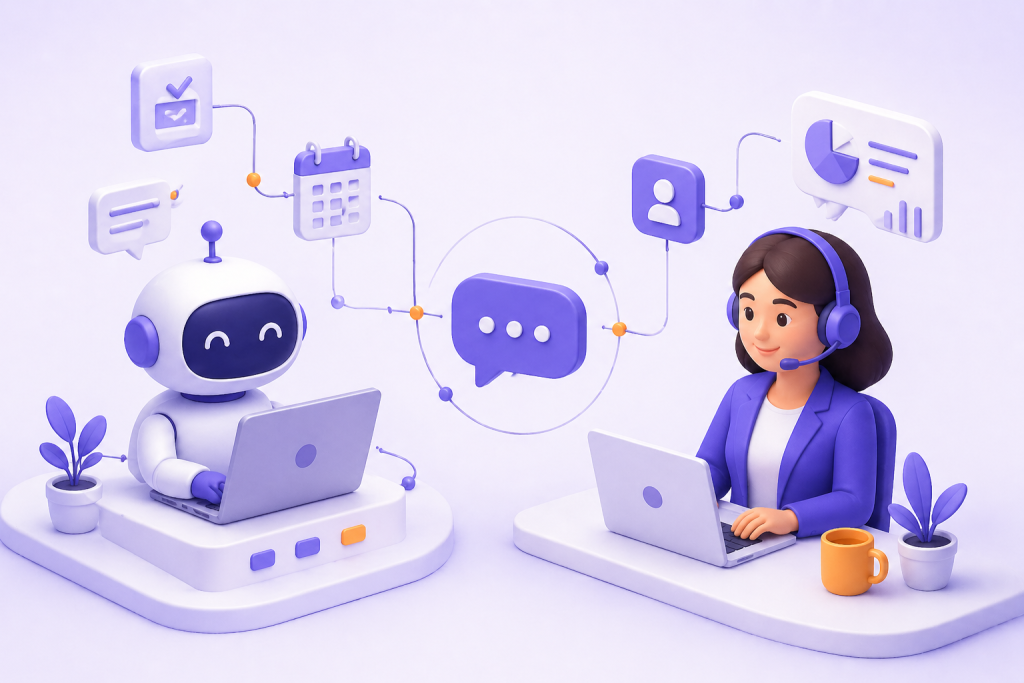
Most Manchester-area SMEs do not need a call centre. They need coverage. The hybrid model that holds up is simple: AI customer service handles first response and admin, humans handle decisions.
Pros
- Faster replies without hiring a full-time receptionist
- Better consistency because staff get suggested answers and knowledge search
- Cleaner handovers with call summaries and tagged conversations
When to use
Use a decision tree that your team can follow on a busy Tuesday:
- Is it urgent or high-stakes? If yes, escalate immediately.
- Is it a standard request? If yes, automation replies using approved content.
- Is it unclear after two questions? Escalate, do not loop.
- Has the customer asked twice for a person? Escalate, no debate.
Practical coverage examples we see work:
- Trades (Greater Manchester): AI triage on web chat and WhatsApp, human callback slots 8am to 10am and 4pm to 6pm
- Salons: AI handles reminders and reschedules, humans handle consultations and complaints
- Restaurants: AI for booking confirmations and FAQs, humans for large parties and allergy exceptions
- Clinics: AI for admin and signposting, humans for anything that looks like clinical advice
If WhatsApp is your main channel, you will get more value from automated lead capture than a fancy bot personality. We covered a practical setup in our piece on turning website visitors into WhatsApp leads automatically.
Costs, risks and UK compliance for AI customer service
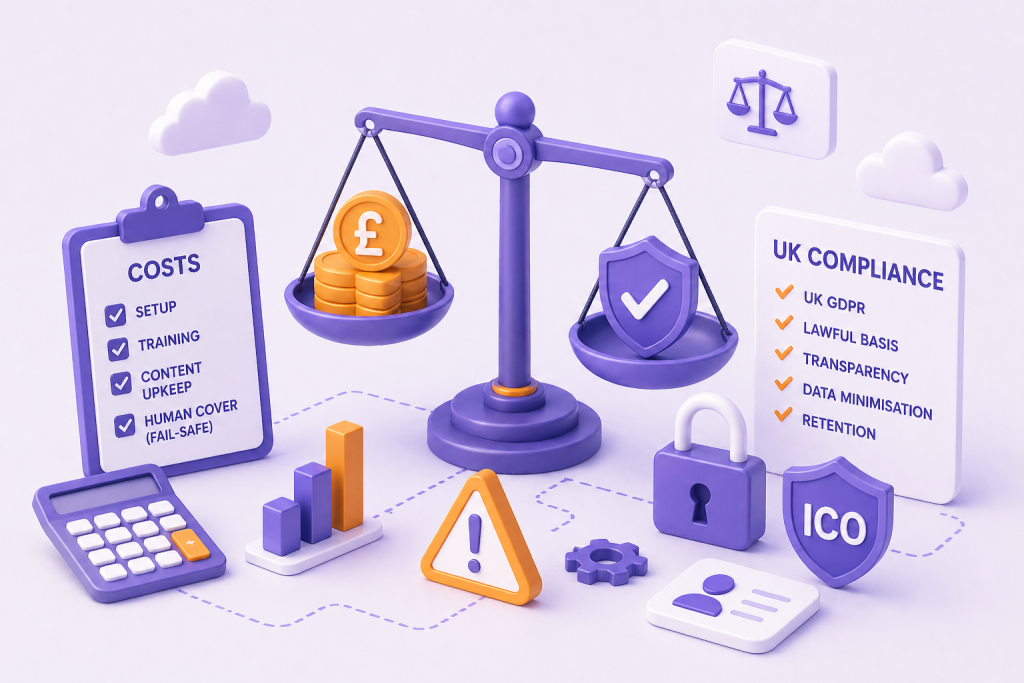
People obsess over the monthly licence and ignore the real costs: setup, training, content upkeep, and human cover when automation fails. If you want a realistic baseline, we broke down typical figures in our AI chatbot cost guide for UK small businesses.
According to the Office for National Statistics, UK businesses have been increasing their adoption of AI in recent releases of the ONS business insights and conditions survey. That trend is real, but it does not mean your business is ready to automate customer messages safely. See the latest updates on the Office for National Statistics website (dofollow).
On compliance, do not wing it. If you process personal data, you are in UK GDPR territory. The ICO is clear that you still need a lawful basis, transparency, data minimisation, and appropriate retention when using AI tools. Use the ICO’s guidance on AI and data protection (dofollow) as your starting point.
Operational risks you should plan for:
- Wrong answers: fix with approved knowledge base and human-in-the-loop rules
- Brand voice: fix with templates and examples, not “make it friendly” prompts
- Sensitive data: fix by restricting what the bot can ask for and storing less
If you are a clinic, use NHS digital comms expectations as a benchmark. NHS England’s guidance on online services and digital channels is a good reminder that clarity and safety beat cleverness (dofollow).
30-day test plan for AI customer service
If you are not measuring outcomes, you are guessing. A 30-day test stops AI customer service becoming a never-ending “tool project”.
Pick three metrics you can actually track:
- Time to first response (by channel)
- Resolution rate (how many conversations end without a chase)
- Complaints or CSAT (even a simple “thumbs up/down” helps)
Then keep the scope tight:
- Choose one channel (web chat is usually safest, WhatsApp second).
- Build top 20 FAQs from real messages.
- Write escalation rules in plain English.
- Train your team on what the bot cannot do.
- Review transcripts weekly and update answers.
Surprising truth: you will often get better results from improving your website’s clarity than from adding more automation. If your pages do not answer basic questions, any bot will struggle.
Head-to-head comparison of AI customer service options
Here is a practical “chatbot vs live chat vs hybrid” view, based on what we see working for SMEs. If you are choosing an AI customer service approach, this is the simplest way to sanity-check the trade-offs.
AI-only support
- Best for: FAQs, out-of-hours, simple booking admin
- Weak for: refunds, complaints, complex diagnosis
- Risk: confident wrong answers and brand damage
Human-only support
- Best for: high trust, premium services, complex situations
- Weak for: slow replies, inconsistent coverage, staff burnout
- Risk: missed leads when you are busy on-site
Hybrid customer support
- Best for: most local services with peaks and troughs
- Weak for: needs setup and ongoing upkeep
- Risk: messy handovers if escalation rules are vague
If you are doing a lot of phone work, focus on call handling for small businesses with agent-assist tools rather than trying to replace the phone line. Customers still expect a person there.
Our verdict
If you are choosing between “AI” and “humans”, you are asking the wrong question. You are really choosing where you can tolerate mistakes.
For most SMEs, AI customer service should sit in the early stages of the customer process: pre-sale questions, booking admin, and triage. Humans should own anything that affects money, safety, or emotion. That hybrid model is the only one we have seen reduce workload without quietly increasing complaints.
One more sceptical point: if your policies are unclear, automation will expose it. Fix your deposit rules, refund wording, and booking terms first, then automate.
Frequently asked questions
Is AI customer service cheaper than hiring someone in the UK?
Usually, yes on monthly cost, no on total cost if you include setup and maintenance. Expect software from tens to a few hundred pounds a month, then time for training, scripts, and weekly review. If you need heavy escalation cover, you still pay for people.
Will customers get annoyed if I use a chatbot?
They get annoyed when it blocks them. Use it for quick answers and booking admin, and make “speak to a person” obvious. Also, do not fake being human, just be clear it is automated.
When should I force escalation to a human agent?
Escalate immediately for refunds, complaints, safety issues, vulnerable customers, and anything involving sensitive personal data. Also escalate when the bot has asked two clarifying questions and still cannot route the issue.
Is using AI for customer messages GDPR compliant in the UK?
It can be, but only if you do the basics properly: lawful basis, transparency, data minimisation, retention rules, and supplier checks. Follow ICO guidance, keep logs, and avoid collecting unnecessary data in chat.
What’s best for local businesses, web chat or WhatsApp?
Web chat is easier to control and less personal, so customers tolerate automation more. WhatsApp often converts better for local services, but you need tighter rules because it feels like a private conversation.
If you want a practical, low-risk way to start with AI customer service, we will help you map a hybrid setup by channel and customer stage, then build the minimum version that actually reduces your workload. Get in touch with Minutes Agency in Manchester and we will review your current messages, booking flow, and escalation points, then suggest a simple plan you can run this month.

