
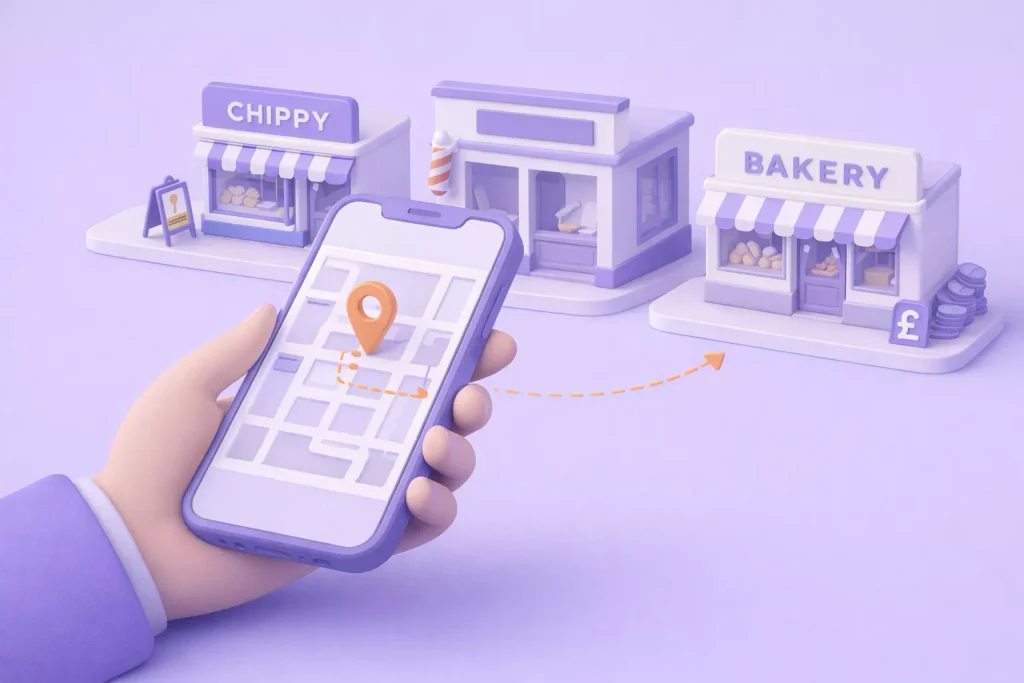
Most local owners in Manchester already have a sales funnel, they just don’t call it that. In practice, your customer path is how people find you on Google, check your reviews, ring for a quote, then either show up or disappear. The trick is making that path visible, measurable, and repeatable, so you stop relying on luck and start relying on a system.
Think of it like a leaky bucket. You can keep pouring more money into ads and posts, but if you don’t patch the leaks (missed calls, slow replies, unclear pricing), you’ll always feel busy without seeing the bank balance move.
What a local sales funnel looks like
Plenty of advice online assumes you sell software with a checkout button. Most UK local businesses sell trust, timing, and convenience, so your sales funnel has a “messy middle”. Expect phone calls, walk-ins, WhatsApp messages, Instagram DMs, and the customer who says “I’ll ask my partner” then vanishes.
Funnel vs pipeline
A funnel is what happens to demand. It answers: how many people found you, how many asked, how many booked, how many came back. A pipeline is what happens to deals. It answers: who is this lead, what stage are they at, what’s the next action.
If you only measure pipeline, you’ll miss the marketing leaks. If you only measure funnel, you’ll miss the follow-up leaks.
Here’s the simple 5-stage model we use for local teams (a practical funnel you can actually track):
- Discover (Google, Maps, ads, referrals)
- Consider (reviews, photos, website pages, social proof)
- Convert (call, booking, walk-in, deposit)
- Retain (repeat visits, reminders, aftercare)
- Refer (reviews, word of mouth, partner intros)
According to the ONS Internet access bulletin, internet use remains near-universal for UK adults, which means even “walk-in” businesses usually get researched online first.
Build your sales funnel from the inside
Most people start at the top, more followers, more traffic, more impressions. We prefer the boring start: your best customers and one core offer. This approach makes your sales funnel easier to improve because you are not scaling a broken conversion path.
It’s like fitting a key before you cut more copies. If the original key is wrong, you just make more wrong keys.
Pick your ideal local customer
Get specific enough that you can say “yes” or “no” quickly:
- Radius: 1 mile, 5 miles, or “within 30 minutes of M1 junction 24”
- Need: emergency, routine, luxury, compliance, health
- Urgency: same-day, this week, “whenever”
- Budget: bargain, mid, premium
A Chorlton clinic and a Stockport emergency plumber don’t need the same messaging, even if both want more leads.
Choose one primary conversion
Pick the action that makes money soonest:
- Calls (great for trades and clinics)
- Online booking (great for salons, classes, restaurants)
- Quote form (great for larger jobs)
- Table reservation (obvious for hospitality)
If you try to optimise for all of them at once, you usually optimise for none.
Build an offer ladder
Your “entry” offer reduces risk, your core offer pays the bills, and add-ons raise average order value.
Example for a local HVAC firm:
- Entry: £79 service check
- Core: boiler repair or replacement quote
- Add-on: annual maintenance plan
Get found locally at the top of your sales funnel
If you’re not showing up where locals look, the rest of your sales funnel doesn’t matter. What we’re seeing across Greater Manchester is that Maps visibility and review quality beat “pretty” branding for first contact, which is why local visibility is a non-negotiable part of any lead generation system.
Google Business Profile basics
Sort these before you touch anything fancy:
- Right primary category and a couple of relevant secondary ones
- Services list that matches what people actually search
- Fresh photos (real staff, real work, real location)
- Weekly posts (offers, updates, seasonal reminders)
- Q&A seeded with common questions (parking, pricing range, turnaround)
If you want the full checklist, our Google Business Profile optimisation walkthrough shows exactly what we update first for local clients.
Local SEO that moves the needle
In practice, two things shift rankings faster than most people expect:
- One strong service page per core service, written for humans
- Review volume and recency, especially with service and area mentioned naturally
Bonus: if your site structure is messy, local schema can help search engines understand your address and services. We broke down what matters in this local schema markup explainer.
Paid visibility without waste
For local lead generation, we usually start with:
- Branded search ads (protect your name from competitors)
- High-intent “near me” searches for your core service
- Simple retargeting so you stay visible after the first visit
The insider tip: don’t run “awareness” ads until your conversion path works. Paying to remind people you exist is pointless if your phone goes to voicemail.
Trust and proof in the middle of the sales funnel
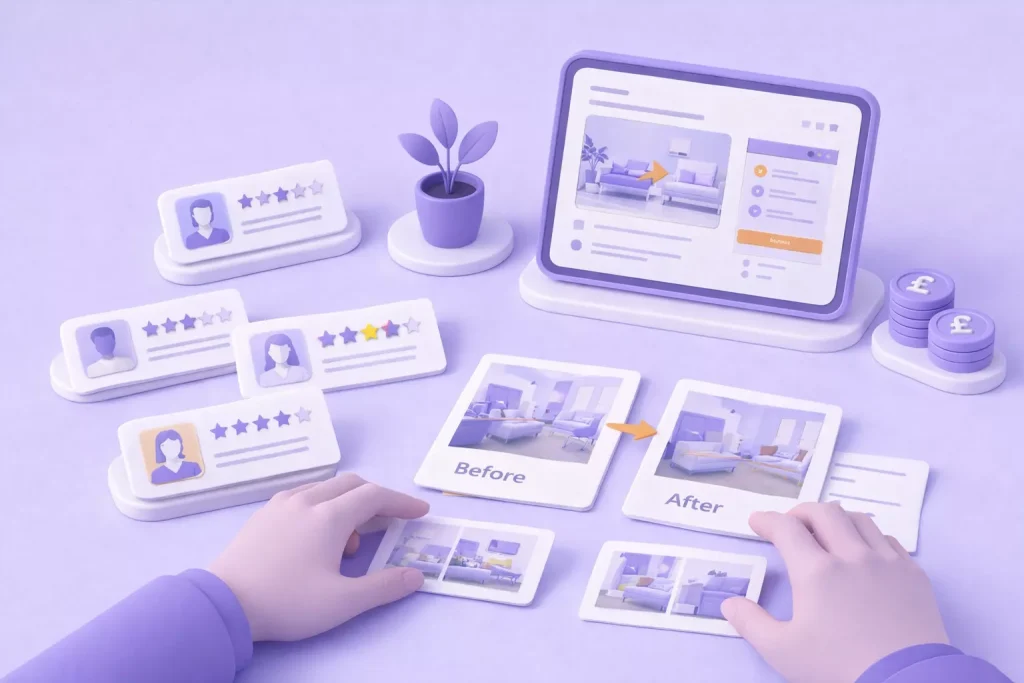
The middle of the sales funnel is where most local businesses win or lose, because people don’t move from “interested” to “enquiry” because you explained your service. They move because they feel safe. The data suggests social proof is doing more of the heavy lifting each year, especially on mobile.
Ofcom’s Online Nation report highlights how central online platforms are to daily decisions, and for local businesses that often translates into “I’ll check reviews first”.
Trust assets that close the gap
What we’re seeing work best for Manchester-area SMEs:
- A review widget with recent reviews, not just a 4.9 badge
- Before/after galleries (salons, builders, dental, cleaning)
- Short case studies with numbers (time saved, cost range, outcome)
- Accreditations and insurance displayed where people decide
Common mistake: hiding proof on a “testimonials” page nobody visits. Put it on service pages and booking pages.
High-intent pages that answer objections
Your best pages do three jobs, and each one supports the next step in your sales funnel:
- Confirm you serve the area (“Salford and Trafford, not just Manchester”)
- Signal pricing honestly (even “from £X” filters out time-wasters)
- Remove doubt with FAQs, availability, and what happens next
If you want examples of layouts that increase enquiries, there’s more in our conversion guide for Manchester businesses.
Convert with calls, bookings, follow-up in your sales funnel
This is where most local funnels fall apart. Not because marketing failed, but because contact is awkward. In a sales funnel, the conversion step is like a shop door: if it sticks, people walk away.
Make contact easy
Match the channel to the job:
- Click-to-call for urgent services and high-value quotes
- WhatsApp for quick questions, photos, and out-of-hours capture
- Online booking system for appointment-based services
- Live chat if you can actually respond fast
If you’re adding booking via Google, it needs to work properly or it creates more admin. We covered the setup in how customers can book from Google.
Response time and simple scripts
In practice, you don’t need “sales training”. You need a repeatable script and a plan for missed calls.
Try this for missed calls:
- Text within 5 minutes: “Hi, it’s Sam at ABC Plumbing in Sale. Sorry we missed you. What’s the issue and postcode?”
- Call back within 30 minutes if possible
- If no reply, one more message the next morning
No-shows and quote ghosts happen. A deposit, clear time windows, and a “next step” message reduce it dramatically.
Confirmation that prevents headaches
Your confirmation should include:
- Deposit link or payment options
- Directions and parking info
- What to bring or prepare
- Cancellation policy in plain English
Retention and referrals that compound in your sales funnel
Most owners obsess over getting new leads, then forget the easiest profit is the customer who already trusts you. We treat retention like the profit stage of the sales funnel, because it’s where margins usually improve and your customer acquisition system becomes more predictable.
Automations that feel human
A few messages, timed well, beat constant posting:
- Review request 24 hours after the job
- Rebooking nudge at the average repeat interval (6 weeks, 6 months, yearly)
- Service reminders (MOT-style) for compliance or maintenance
Insider tip: send review requests from a real person’s name, not “noreply@”. Response rates jump.
Referral loops that fit local life
Partnerships work brilliantly in Manchester because communities overlap. Pair up with a nearby business that serves the same audience but isn’t a competitor.
Examples:
- Barber and men’s skincare clinic
- Physio and gym
- Kitchen fitter and local electrician
Offer something simple like “£20 off your next visit when you bring a friend”. Track it with a code so you know it worked.
Measure your sales funnel safely
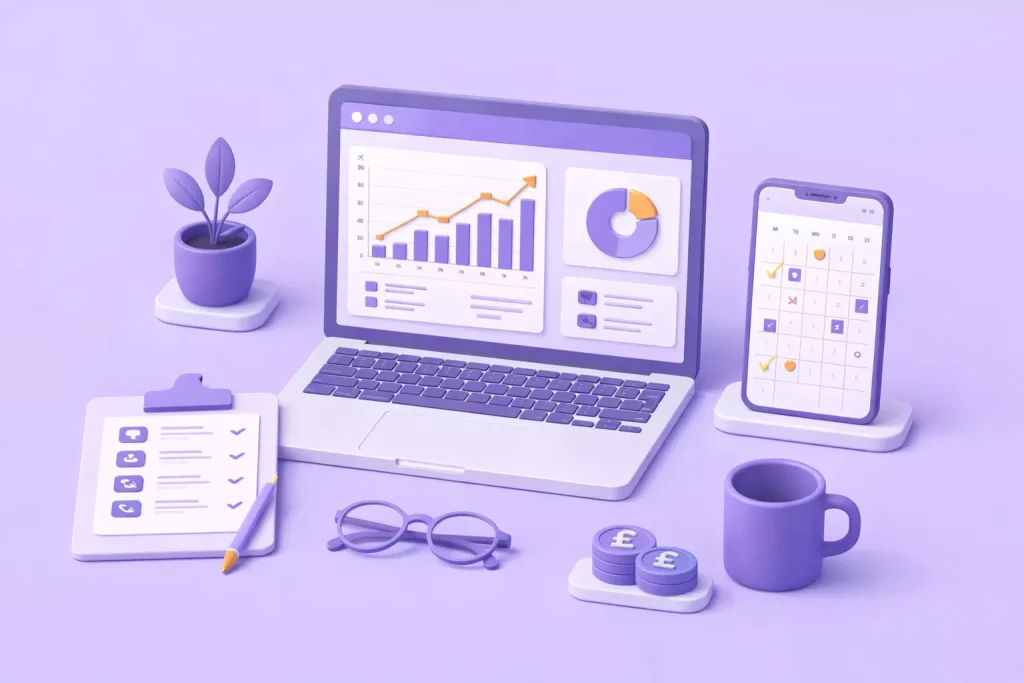
If you can’t see where enquiries come from, you’ll keep guessing. Measuring your sales funnel does not require expensive software, as long as you pick the right signals.
Track what matters
Start with four numbers:
- Enquiries by channel (Maps, organic, paid, referrals)
- Enquiry-to-booking conversion rate
- Cost per lead (CPL)
- Customer lifetime value (LTV) estimate
A practical tracking stack
You don’t need a “big tech” setup. Use:
- GA4 events for form submits and key button clicks
- UTM links on ads and social profiles
- Call tracking numbers (one per main channel if possible)
- Booking tags inside your booking platform
If you want a simple blueprint, our lead tracking setup for UK SMEs breaks it down step by step.
GDPR and PECR basics
You can follow up with customers, but you need to do it properly.
- GDPR: have a lawful basis, keep data secure, don’t keep it forever
- PECR: email and SMS marketing usually needs consent, with limited “soft opt-in” exceptions for existing customers
The clearest starting point is the ICO’s direct marketing guidance. If you’re unsure, get advice before you start blasting texts.
Practical recommendations for your sales funnel
If you’re busy and want progress this month, do these in order. Think of it like tidying a stockroom before you order more stock. You’ll find what’s already working, and you’ll stop wasting money across your sales funnel.
- Pick one conversion goal (calls or bookings) and optimise for it
- Fix Google Business Profile categories, services, and photos
- Add proof to the pages people actually land on (reviews, before/after)
- Set up basic UTMs and call tracking for your top 2 channels
- Write a missed-call follow-up script and stick it by the phone
- Add one retention trigger (review request or rebooking reminder)
If you want to reduce admin while improving response times, light-touch automations can help, as long as they don’t annoy customers. We listed practical options in AI automation workflows.
For more ways to strengthen the top of your sales funnel with local visibility, see our local SEO services in Manchester.
For a deeper look at how we structure local lead generation, you can also read our PPC management services in Manchester page.
You might also find our Google Business Profile optimisation guide useful alongside this, especially if Maps is your main source of enquiries.
Frequently asked questions
What are the stages of a sales funnel for a local service business?
Use five stages: Discover, Consider, Convert, Retain, Refer. It mirrors how locals actually behave, including calls, walk-ins, and repeat visits.
How do I build a sales funnel if most of my customers call or walk in?
Treat calls and walk-ins as conversions, then work backwards. Use click-to-call buttons, track calls by channel, and train staff on a simple script so every enquiry gets the same next step.
Do I need a CRM to create a sales funnel for a small local business?
Not at first. A spreadsheet plus call tracking and booking tags can get you moving. Once you’re handling 20 to 30 enquiries a week, a CRM usually pays for itself by stopping leads slipping through.
How can I track which marketing channel generated a phone call or booking?
Use UTMs for links, unique call tracking numbers for key channels, and booking tags for appointment sources. You’re aiming for “good enough to decide”, not perfect attribution.
Is it legal to text or email customers for follow-ups and offers in the UK?
Yes, if you follow GDPR and PECR rules. Service messages (like appointment reminders) differ from marketing messages (like offers). Check the ICO guidance, and make opting out easy.
If you want a sales funnel that matches how local customers behave in Manchester, build a hybrid system: online discovery, offline conversion, and tracking that tells the truth. Once you can see where leads come from and where they drop off, improvements become obvious and your marketing spend stops feeling like a gamble.
Want a second opinion on your setup? Get in touch with Minutes Agency and we’ll review your funnel, tracking, and follow-up flow, then tell you the quickest wins for your business.

