

Most owners we speak to in Manchester aren’t short on ideas, they’re short on certainty. Your UK marketing budget should not be a finger-in-the-air number, because cash flow does not care about vibes. What actually works is boring: set a baseline you can sustain, then earn the right to scale with simple unit economics.
Despite what you may have read, there isn’t one “correct” percentage for everyone. Some businesses can spend 3% and grow, others need 15% just to stay visible in a competitive postcode. The trick is knowing which one you are.
Background and context
You’re running a UK small business, maybe a trades firm in Salford, a clinic near Didsbury, a restaurant in the Northern Quarter, or a tech-led SME selling B2B services across the North West. Your UK marketing budget has to reflect reality, not generic advice like “post more”, “run some ads”, or “do SEO”. None of that answers the real question: how much can you spend without putting payroll, rent, and VAT at risk?
We also need to be honest about what “small business” means in the UK. According to the Department for Business and Trade business population estimates 2024, most UK businesses are SMEs, and the majority are micro businesses. That matters because micro firms cannot run marketing like a big brand, even if the advice online pretends they can.
If you’re still defining what “good” looks like, start with outcomes and measurement first. Our guide to lead tracking for UK SMEs shows a simple way to connect spend to enquiries.
If you’re planning your spend from scratch, it also helps to understand what you are optimising for. See our internal guide to marketing KPIs for small businesses to choose metrics that match your sales cycle.

The challenge
The conventional wisdom is misleading because it treats marketing as a fixed cost. A UK marketing budget works better when you treat marketing as a variable cost that should flex with demand, margins, and your ability to fulfil the work.
Here’s what tends to be at stake:
- You spend too little and rely on word of mouth, then a quiet month hits and you panic.
- You spend too much, too fast, and cash flow collapses before results land.
- You spend “about right” but on the wrong mix, so leads arrive but don’t convert.
A brutal truth we see a lot: owners blame the channel (Google Ads, Meta, SEO) when the real problem is the offer, the follow-up, or the booking flow. Fixing that usually beats doubling spend, even if your overall marketing spend stays the same.
The approach
You don’t need a 30-tab spreadsheet. You need a decision-first framework for your UK marketing budget: set an always-on baseline, protect cash flow, then scale using CAC, LTV, and payback.
A sensible baseline
If you’ve got no data yet, start with a baseline you can keep running for 6 months without stress. For many local service businesses, that’s usually £500 to £2,000 per month for a mix of local visibility, basic content, and lead handling.
If you want a rough revenue rule, here’s what holds up more often than not:
- New or repositioning: 8% to 15% of turnover (you’re buying attention).
- Steady local business: 5% to 10% (you’re protecting demand).
- Mature, referral-heavy: 3% to 6% (you’re staying credible).
The % approach fails when revenue is lumpy or low (common in trades and project work). In that case, build a cash-flow floor first, then work up.
Benchmarks and splits
If you insist on benchmarks, use three numbers for your UK marketing budget: your “always-on” cost, your test pot, and your scale pot.
A practical split we use for SMEs:
- 60% always-on: local SEO, Google Business Profile, reviews, email list, basic content.
- 20% testing: small experiments (new ads, new landing page, new offer).
- 20% scaling: only goes up when tests hit targets.
Now the sceptical bit. Most people treat ads as the always-on part and SEO as the “nice to have”. For local UK businesses, it’s often the other way round, because maps and reviews keep working while you sleep.
If you’re trying to sort the local basics, start with your listing setup and booking process. There’s more on that in our piece on letting customers book straight from Google.
CAC, LTV and payback maths
This is where your UK marketing budget stops being a guess.
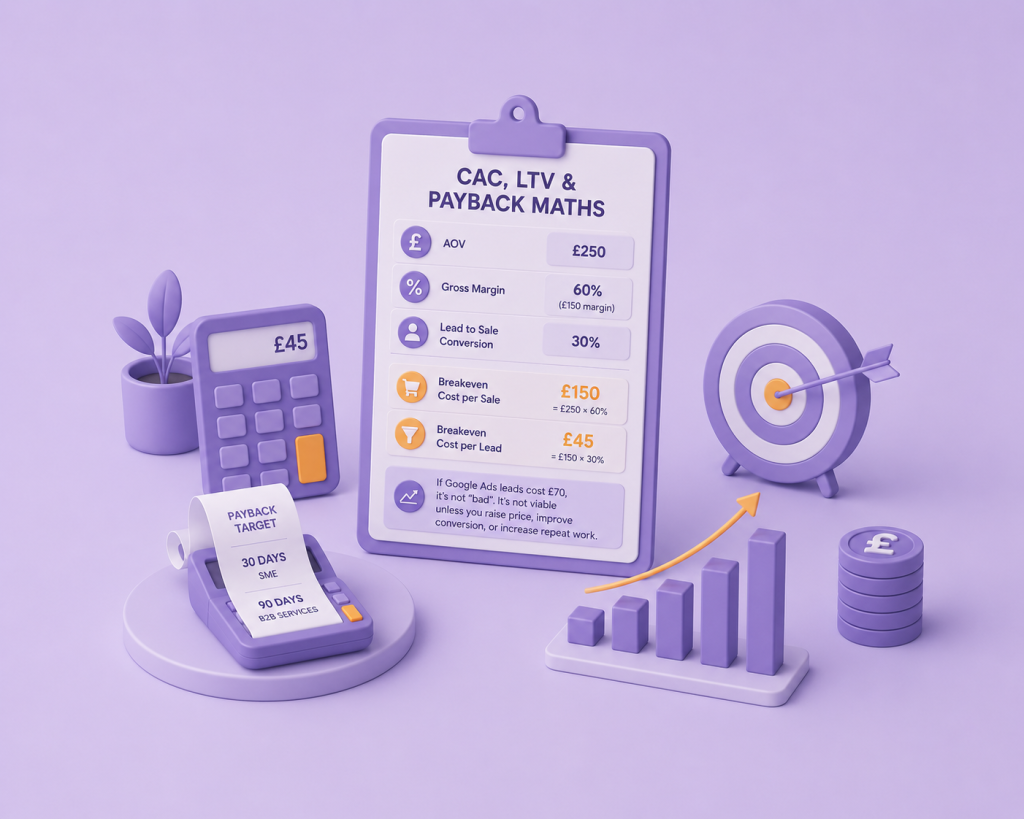
Use this simple worksheet logic:
- Average sale value (AOV)
- Gross margin % (not revenue, margin)
- Leads to sale conversion %
Then:
- Breakeven cost per sale = AOV × gross margin
- Breakeven cost per lead = breakeven cost per sale × lead-to-sale conversion %
Example (local service):
- AOV: £250
- Gross margin: 60% (so £150 margin)
- Lead-to-sale: 30%
Breakeven cost per sale: £150
Breakeven cost per lead: £150 × 30% = £45
If Google Ads is giving you leads at £70, it’s not “bad”, it’s just not viable unless you raise price, improve conversion, or increase repeat work.
Payback matters too. If you need cash back in 7 days, you can’t run long nurture campaigns and hope. For many SMEs we set a payback target of 30 days; for B2B services, 90 days can be realistic.
The results
Once you run the numbers, your UK marketing budget decisions get simpler. You stop arguing about channels and start choosing what fits your margins and cash cycle.
Here are three Manchester-style budget examples we see work in practice.
Local service and trades (postcodes matter):
- Turnover: £300k
- Baseline: £1,200 per month
- Split: £500 local SEO and reviews, £500 Google Ads in tight radius, £200 call tracking and CRM
- KPI: qualified calls per week
Clinic, salon, restaurant (bookings and repeat):
- Turnover: £500k
- Baseline: £2,000 per month
- Split: £600 local search visibility, £800 Meta for offers, £400 email/SMS retention, £200 creative
- KPI: bookings, plus repeat rate
Tech or IT services SME (longer cycle):
- Turnover: £1m
- Baseline: £4,000 to £8,000 per month
- Split: £1,500 content and case studies, £1,500 LinkedIn, £500 CRM and tracking, rest on landing pages and remarketing
- KPI: sales-qualified opportunities
A quick reality check: digital reach is there, but attention is fragmented. Ofcom’s Online Nation 2024 reports continued heavy use of online services and platforms across UK adults, which is why digital channels usually earn the first slice of budget. It doesn’t mean you should be everywhere, it means your customers are.
Lessons learned
Most people overcomplicate channel mix and underinvest in basics. Your UK marketing budget will not perform if your website loads slowly, your tracking is broken, or your follow-up is manual chaos, because you’ll burn money on any platform.
Here’s a channel mix that tends to work for UK SMEs:
- Local intent: Google Business Profile, reviews, Maps, and local SEO UK pages.
- Demand capture: Google Ads for “ready to buy” searches.
- Demand creation: Meta, LinkedIn, short-form video, email.
- Measurement: GA4, call tracking, CRM, consent banners.
Martech costs are real. A CRM, tracking, and reporting can easily be £50 to £300 per month in tools alone, before anyone sets it up properly.
Insider tip: don’t “save money” by skipping lead tracking. You’ll end up paying for the same lesson twice. If you want a simple setup that’s not overkill, this lead tracking walkthrough for UK SMEs is a solid starting point.
Common mistake we still see: throwing spend at ads before fixing conversion. If you want the highest ROI change most SMEs can make, start with your pages and enquiries flow. We’ve laid out the practical fixes in our guide on turning website visitors into customers.
If you want to prioritise spend properly, also see our guide to Google Ads vs SEO to decide what your marketing budget should fund first based on timeline and risk.

Frequently asked questions
What percentage of turnover should a small business spend on marketing in the UK?
A typical small business marketing budget percentage UK sits around 5% to 10% of turnover, but it’s only useful if your margins and cash flow support it. If your work is seasonal or invoice-heavy, treat the percentage as a sense check, not a rule, and sanity-check it against your baseline marketing budget.
How much should I spend if my business is new or pre-revenue?
If you’re pre-revenue, cap spend to what you can afford to lose while you validate the offer. We usually advise a 90-day test pot (often £500 to £2,000 total) focused on one channel, one landing page, and one conversion action, so your marketing spend stays controlled while you learn.
Should I invest more in SEO or Google Ads?
For a local UK business, SEO and Google Business Profile work best as the “always-on” foundation, with Ads layered on for speed and control. If you need leads this month, Ads helps. If you want cheaper leads over time, local SEO UK work usually pays off.
If you’re stuck choosing, our Google Ads vs SEO breakdown explains what to fund first based on your timeline.
How do I calculate a realistic cost per lead and cost per acquisition?
Start with margin, not revenue. Work out your breakeven cost per sale (AOV × gross margin), then multiply by your lead-to-sale conversion rate to get breakeven cost per lead. Track actuals weekly, and adjust conversion before you increase spend, so your marketing budget scales safely.
Is marketing spend tax-deductible for UK small businesses?
Often, yes, marketing and advertising can be allowable business expenses if they’re wholly and exclusively for business purposes. Your accountant should confirm for your situation, especially around entertaining and mixed-use costs.
Conclusion
A UK marketing budget that works isn’t about copying someone else’s percentage. Set an always-on baseline you can sustain, protect cash flow first, then scale only when your CAC, LTV, and payback period say it’s safe. If that sounds strict, good, it’s meant to stop you paying for expensive guesswork.
Want a second opinion on your numbers and channel mix? Get in touch with us at Minutes Agency in Manchester and we’ll sanity-check your budget, tracking, and 90-day plan, then tell you plainly what we’d do next.

